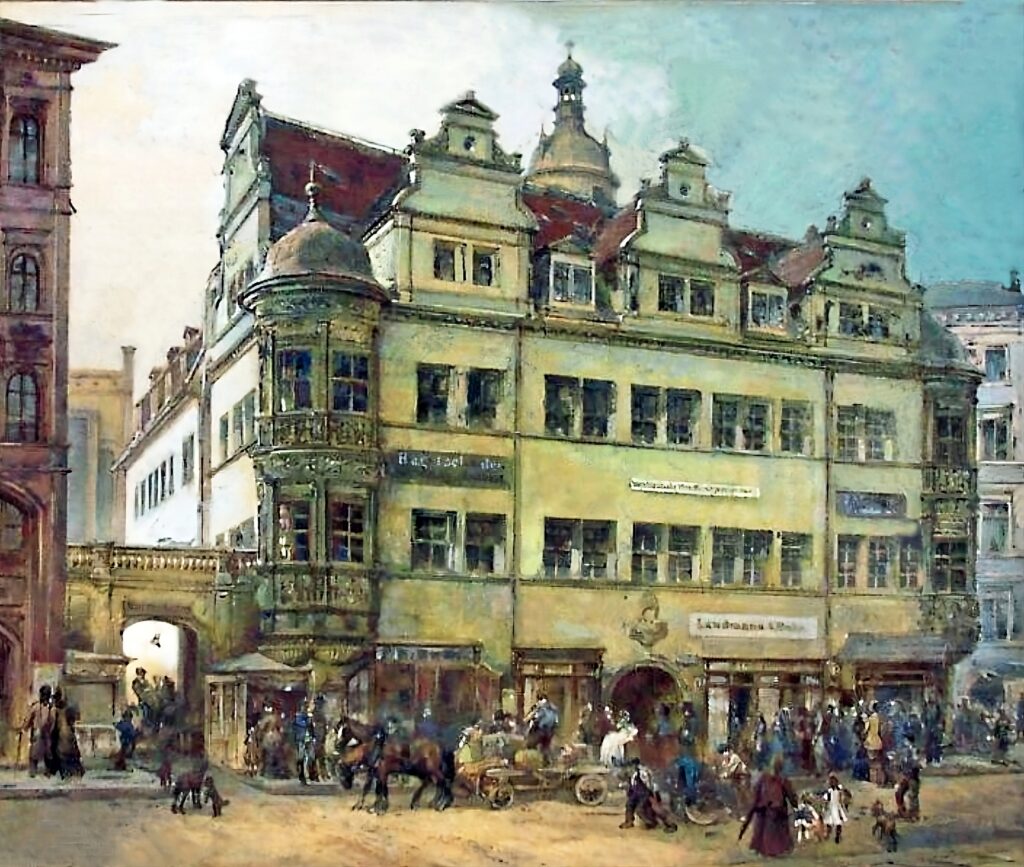
The Fürstenhaus (“Princes’ House”)
In 1558, over 450 years ago, the Leipzig merchant Dr Georg Roth commissioned the stonemason Paul Wiedemann to design what became the most magnificent bourgeois house of the Leipzig Renaissance at Grimmaische Straße 30, directly opposite today’s Fürstenerker building. The two-storey residence was crowned with gables and framed on either side by two round bay windows (Runderker), crafted from red Rochlitz porphyry tuff. These represented the most remarkable architectural sculpture of that era in the trade-fair city. In 1612, four princes from Altenburg lived there while studying at Leipzig University, it was subsequently called the Fürstenhaus (“Princes’ House”). It is also recorded that Tsar Peter the Great lodged in the building in 1713. By that time, it was already owned by the neighbouring university. The building was destroyed during the Second World War. When the ruins were demolished, the two relatively well-preserved bay windows were salvaged and stored in the Moritzbastei.
A Masterpiece of Sculpture
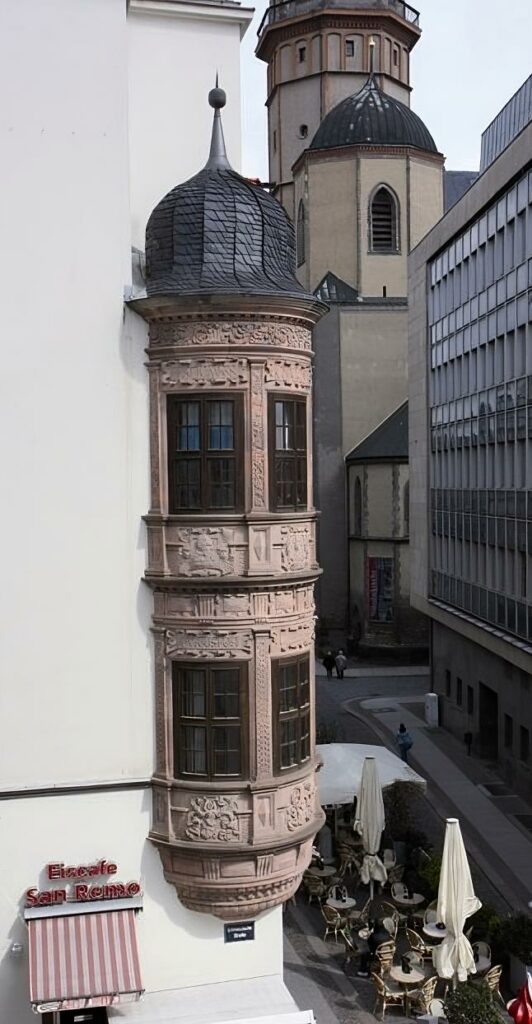
The magnificent round bay window (Fürstenerker) on the building at Grimmaische Straße 17, which we can once again admire today, is a copy of one of the two almost identically designed round bays. It was added in 1986 to the corner of the new residential building. The Dresden sculptor Christian Hempel, together with Leipzig stonemasons from the municipal heritage preservation company, recreated Paul Wiedemann’s masterpiece based on surviving fragments of the two Renaissance bays as well as historical photographs. The two-storey round bay window with its Welsh slate roof is modelled on the round bay window designed by Kunz Krebs (†1540) at Hartenfels Castle in Torgau. The parapet panels of the bay window feature coats of arms on the first floor and cartouches with portraits of the owner family on the second floor.
Above the six windows, framed in typical Renaissance scrollwork, runs the Latin inscription “Turris fortissima nomen domini beati omnes qui confiunt in eo”, which means “The strongest tower is the name of the Lord; blessed are all who place their trust in Him.” The bay also features other sculptural details typical of the period, such as interlaced bands and hanging garlands separating the windows, as well as diamond cubes and an egg-and-dart frieze. At the base, on the corbel stone, Wiedemann’s stonemason’s mark can be seen.
A visible symbol of the economic and cultural flourishing of the Renaissance era is the Old Town Hall on the Market Square, built in 1556/57, which still stands today. Under the leadership of Mayor Hieronymus Lotter, Paul Wiedemann played a decisive role in its construction and decoration. Together, they left a distinctive mark on the architecture of Leipzig’s High Renaissance. The 16th century also saw in Leipzig the transition from half-timbered houses to stone-built bourgeois houses, with projecting bay windows becoming a characteristic Leipzig tradition.
 English
  German